
Quick Start
Account Type
Tools & Resources
Tools
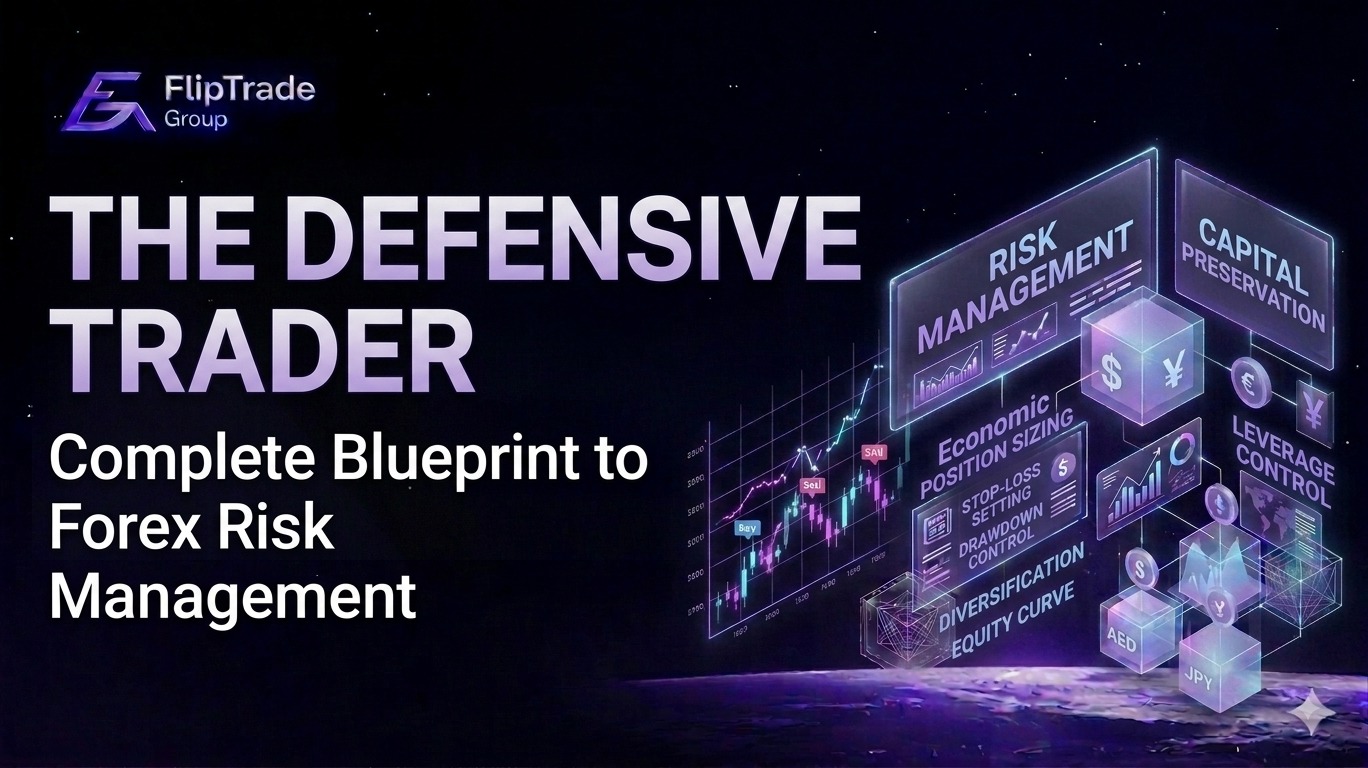
Entering global currency markets without a capital protection strategy is the fastest route to account depletion. Most novice market participants enter trades focusing entirely on potential profits, completely overlooking what happens if price moves against us. As seasoned market participants, we recognize a fundamental reality early on: staying in the game matters far more than any single trade outcome. Risk control forms the bedrock of our overall portfolio strategy.
Developing a defensive mindset transforms market participation from speculative gambling into a controlled, professional endeavor. By establishing clear risk protocols before placing orders, we neutralize emotional reactions and maintain account stability during unavoidable drawdown periods. Accessing a dependable best forex trading platform provides us with the essential technological tools—such as instant order routing, transparent execution, and automated stop systems—needed to implement these capital management safeguards smoothly. At FlipTrade Group, our mission focuses on empowering traders with an environment engineered for financial security and long-term discipline.
Capital management is the true lifeblood of sustainable trading. Without explicit boundaries around downside exposure, even a high-win-rate technical system will eventually fail due to an inevitable series of losing trades.
Protecting Our Trading Capital
Our account balance represents our operational working inventory. Protecting capital ensures we retain sufficient purchasing power to capture upcoming high-probability opportunities. When an account suffers severe losses, the percentage gain required to break even grows exponentially, making recovery significantly harder.
Limiting Drawdown Exposure
Drawdowns represent natural performance dips across market cycles. Controlling the depth of these drawdowns prevents catastrophic account damage, allowing our portfolio to recover steadily once market conditions align with our strategy again.
Reducing Emotional Pressure
Trading without risk boundaries triggers intense psychological stress. When money on the line exceeds comfortable limits, fear and greed dominate decision-making. Pre-defining our risk exposure keeps us calm, analytical, and objective while market positions remain active.
Establishing Long-Term Consistency
Systematic risk control shifts our focus away from individual trade outcomes toward long-term probability. Consistent exposure rules allow our statistical edge to play out predictably over large trade sample sizes.
Navigating Market Volatility
Global currency markets react instantly to economic releases, geopolitical shifts, and sudden liquidity gaps. Structured risk controls shield our balances from severe price slippage and unexpected directional spikes.
Position sizing dictates exactly how many lots or units we trade on a given setup. It remains our single most powerful lever for controlling risk, regardless of market volatility levels.
Choosing Appropriate Trade Sizes
Determining trade size based on our personal account size rather than profit targets prevents over-leveraging. Fixed dollar allocation ignores technical stop distances, whereas calculating lot sizes dynamically based on market structure aligns our exposure perfectly with chart context.
Avoiding Oversized Positions
Opening oversized positions exposes our accounts to ruin during normal statistical losing streaks. A single oversized trade can wipe out weeks of carefully accumulated profits, destroying overall equity curves.
Managing Account Balances
Treating our trading capital as a long-term business asset requires maintaining a safe buffer. Adjusting position sizes dynamically as account equity fluctuates upward or downward ensures proportionate capital exposure at all times.
Applying Our Fixed Percentage Rule
In our daily routine, we strictly cap individual trade risk between 1% and 2% of total equity. Restricting exposure to this threshold allows our account to survive ten consecutive losses while preserving over 80% to 90% of our overall capital.
A stop-loss order acts as an automated safety net, closing out an open trade once price hits our pre-designated invalidation level.
Why Every Position Requires Invalidation Boundaries
Entering a position without a hard stop-loss is equivalent to driving without a seatbelt. A stop-loss establishes the exact point where our initial trade thesis is proven wrong, taking emotion completely out of trade management.
Stop-Loss Placement Methodologies
Effective stop placement relies on objective market structure rather than arbitrary dollar values:
Structural Placement: Position stops beyond recent swing highs or swing lows to allow natural price breathing room.
Volatility Placement: Utilize technical tools like the Average True Range (ATR) to adjust stop distances based on current market expansion.
Support and Demand Boundaries: Place protective exits just outside verified demand or supply zones to avoid premature stop-outs during noise sweeps.
Guarding Against Sudden Market Shifts
Unplanned news announcements or central bank commentary can move exchange rates hundreds of pips within seconds. A working stop-loss ensures that extreme volatility does not turn a manageable loss into an account-ending event.
The risk-to-reward ratio (RRR) evaluates expected downside risk against potential upside payout for any given setup.
Defining the Metric
If we risk $100 to target a $300 profit, our trade setup offers a 1:3 risk-to-reward ratio. This relationship forms the core foundation of positive mathematical expectancy over time.
Why RRR Supersedes High Win Rates
Many novice traders focus solely on achieving high win rates, assuming that winning 80% of trades guarantees profitability. However, an approach with a 30% win rate using a strict 1:3 RRR will outperform an 80% win-rate trader who lets losses run without control.
Practical Application
Consistently taking setups with a minimum 1:2 or 1:3 RRR means our strategy remains profitable even if we lose more than half of our trades overall.
Leverage allows us to control larger market positions using a smaller initial margin deposit. While leverage boosts capital efficiency, it amplifies risk equally in both directions.
Using high leverage without calculating underlying lot exposure leads to extreme equity swings. True risk stems not from leverage ratios provided by brokers, but from total position sizes held relative to our overall account balance. When accessing reliable trading platforms for forex, maintaining conservative position sizing ensures leverage serves as a useful tool rather than an account hazard. At FlipTrade Group, we provide transparent leverage parameters and flexible account options to ensure our traders maintain complete risk oversight.
To see risk management principles in action, let us compare two contrasting trading approaches over a sequence of 10 trades using $10,000 starting balances.
TRADER A: Aggressive Approach
• Risk Per Trade: 10%
• Stop Loss: None / Arbitrary
• Win Rate: 40%
• Result: Rapid Account Depletion / Margin Call
TRADER B: Systematic Risk Control
• Risk Per Trade: 1%
• Risk-to-Reward Ratio: 1:3
• Win Rate: 40%
• Result: Sustainable Equity Growth
Trader A risks 10% ($1,000) per trade without defined stop losses. After suffering four consecutive losses—a completely normal statistical streak—Trader A loses $4,000, representing a massive 40% drawdown. Panicked, Trader A takes emotional trades to recover losses quickly, eventually triggering a margin call that wipes out the account.
Trader B limits risk to exactly 1% ($100) per trade while targeting a 1:3 risk-to-reward ratio ($300 target). Even after experiencing the same four consecutive losses, Trader B drops only $400, leaving account equity virtually intact at $9,600. When Trader B hits four winning trades out of ten, gains a total of $1,200. Ending the sequence with four wins and six losses, Trader B still nets a comfortable +$600 profit (+6% net gain).
Eliminating recurring tactical errors preserves our capital and stabilizes long-term equity growth:
Overtrading: Taking low-quality setups out of boredom or attempting to force market profits.
Trading Without Stop Losses: Leaving trades open indefinitely hoping price will eventually turn back in our favor.
Risking Excessive Capital: Exposing large percentages of our account balances to individual market movements.
Revenge Trading: Immediately re-entering markets emotionally after a loss to win money back quickly.
Moving Stop Losses Away: Widening stop distances mid-trade to avoid taking a small, planned loss.
Ignoring Economic Calendars: Trading through major high-impact news events without accounting for wide spreads and volatility.
Long-term market survival relies on turning risk parameters into daily habits through systematic discipline.
Maintain Personal Discipline: Treat every trade as a business decision, respecting our pre-set rules regardless of short-term market noise.
Apply Consistent Risk Controls: Keep percentage exposure uniform across all our trade setups to allow the probability edge to function naturally.
Log Execution in a Journal: Document entries, exits, position sizes, and our emotional state for every trade setup.
Audit Performance Regularly: Review our trading journals weekly to catch bad habits, adjust execution rules, and refine strategic precision.
Mastering risk management turns market participation into a systematic, repeatable process. By calculating our position sizes carefully, enforcing structural stop losses, targeting favorable risk-to-reward ratios, and managing leverage responsibly, we keep capital protected through all market environments.
Executing a disciplined risk strategy requires a stable, high-performance broker environment equipped with ultra-fast order routing and real-time capital oversight. For participants seeking the best forex trading experience, FlipTrade Group provides the transparent conditions, responsive tools, and execution stability needed to build a sustainable trading career. Let us apply these risk management principles today and take total control over our financial journey!


Flip Trade Group Ltd ( Company No. 232118 ), is incorporated in Mauritius and regulated under License Number: GB26205911.Registered Office:4th Floor, The Docks 4The Docks, CaudanPort Louis, Mauritius
4th Floor, The Docks 4, The Docks, Port Louis, Mauritius
4th Floor, The Docks 4, The Docks, Port Louis, Mauritius
+230 52515560
support@fliptradegroup.com
4th Floor, The Docks 4, The Docks, Port Louis, Mauritius
4th Floor, The Docks 4, The Docks, Port Louis, Mauritius
+230 52515560
support@fliptradegroup.com
Risk statement : An investment in derivatives and financial markets involves high risk and may result in losses greater than your initial investment. Trading in securities, forex, commodities, options, and futures is not suitable for everyone, and you should only invest money you can afford to lose. Before investing, ensure such activities are permitted in your country and seek independent financial, legal, or tax advice. FlipTrade Group Limited does not provide services to residents of the United States, Cuba, Iraq, Myanmar, Russia, North Korea, or Sudan, and its services are not intended for jurisdictions where they would contravene local laws or regulations. Nothing on this site should be considered financial advice.
© FlipTrade Group Limited 2026 | All Rights Reserved
